CESA asked developers for the first time, and six in ten said they use it daily
CESA published the preview edition of its 2026 game industry report on 17 September with two first-time surveys inside. 85.8% of developers said they use generative AI at work and 63.0% said they use it daily. There is no prior year to compare against.
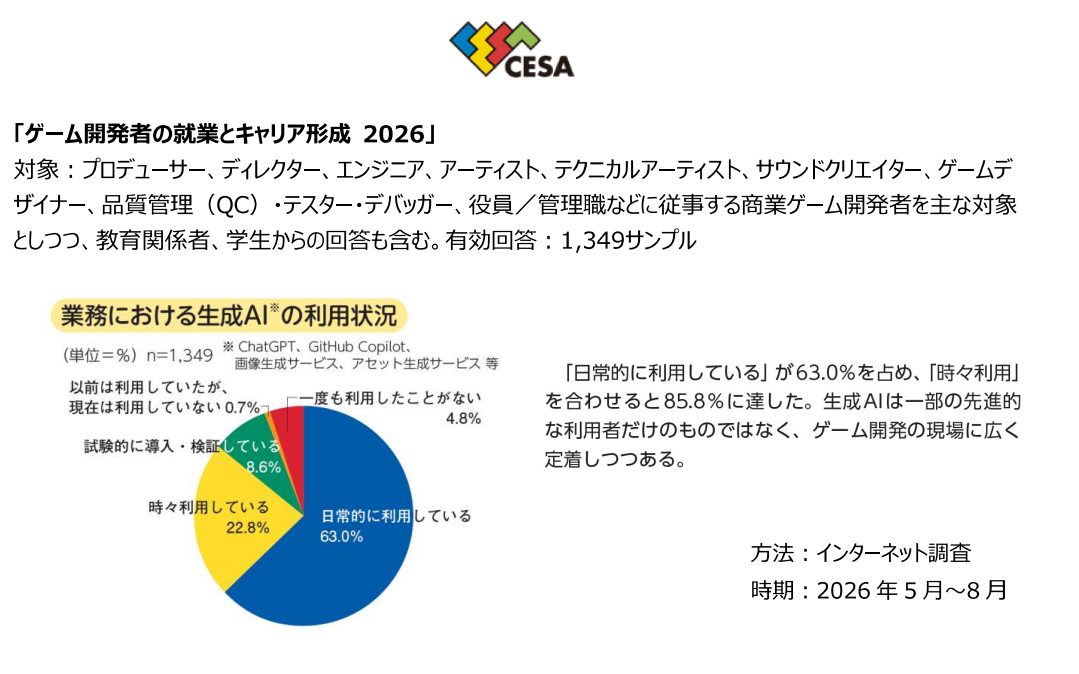
The Computer Entertainment Supplier’s Association (CESA) published the preview edition of the CESA Games White Paper 2026 on 17 September 2026 [1]. The report carries two surveys CESA ran in 2026, both appearing for the first time. One went to game developers, the other to CESA member companies [1]. In the developer survey, 85.8% of respondents said they use generative AI in their work [1]. This article is current as of 19 September 2026.
Seven times as many use it daily as are still evaluating it
The 85.8% figure only separates those who use generative AI from those who do not. Inside it, 63.0% said they use it routinely and 22.8% said they use it occasionally [2]. Another 8.6% said they are trialling it for evaluation, 4.8% said they have never used it and 0.7% said they used to but no longer do [2].
The gap worth noting is the one between 63.0% and 8.6%. More than seven times as many people already reach for it every day as are still deciding whether it works. The adoption question is settled on the floor: it was open yesterday and it is open today. Only 0.7% stopped using it. That almost nobody tried it and walked away is not the same as everybody being happy with it. A tool that has entered a workflow is hard to pull back out.
The developers and the companies answered different surveys
The preview edition carries two surveys, and the respondents differ. The 85.8% came from game developers describing their own work, while the expected benefits and the management measures came from CESA member companies answering as employers [1]. One side described what happens at the desk. The other described what company policy allows.
Asked what they expect most from generative AI, member companies named efficiency and higher productivity [1]. Asked how they manage its use, the answer that drew the most responses was that a person checks, corrects and reviews the output [1]. Restricting or designating which tools may be used, and not shipping model output as-is, also drew many responses [1].
Developers using it daily and companies deciding not to ship its output are both true at once. For anyone buying the games, the two answers read together like this: under the rules most member companies picked, what ends up in a finished game has passed through a person one more time. The more generative AI enters production, the more the work shifts from generating to reviewing.
The preview goes out at the show, the book arrives in December
The preview edition is not for sale and is handed to press at Tokyo Game Show 2026 [1]. The full edition is scheduled for early December [1]. The 85.8% and 63.0% being quoted now are an advance slice of what that December book will contain. Because the on-site copies are for press, the point at which a general reader can open the same material is December [1].
This is the first time CESA has surveyed game developers directly [1]. There is no figure from last year to set beside it. Whether 85.8% is a rise or a fall cannot be answered from this one survey. The direction will only be visible once a second survey exists, and until early December these two numbers are all that has been published about the state of Japanese game production.
Sources
[1] Computer Entertainment Supplier’s Association. Announcement of the CESA Games White Paper 2026 Preview Edition. CESA, 17 September 2026.
[2] Kang Min-woo. 85.8% of Japanese game developers say they use generative AI at work, CESA’s first survey. Inven, 18 September 2026.
Screenshots
Images: official CESA assets
Source: CESA (Computer Entertainment Supplier's Association) ↗