Five percent is more than eight times HoYoverse's rate, so why does hololive Dreams feel stingy?
hololive's first official mobile game puts a theme park on an empty island and runs more than 150 songs through it. The top rarity drops at 5 percent, over eight times what HoYoverse advertises, and twelve new 5-stars entered the pool between July 28 and August 17.
The arithmetic behind a generous rate that does not feel generous
Five percent for a top-rarity pull is a good number. Put it next to the reference point everyone in the genre uses and it looks better still: HoYoverse, the studio behind Genshin Impact and Honkai: Star Rail, publishes a 0.6 percent rate on its featured banners. hololive Dreams advertises 5 percent for a 5-star, more than eight times that. Players still call the gacha stingy, and they are not being unreasonable.
Line up the dates and the reason surfaces. The game went live on July 23, 2026. Five days later, on July 28, the first swimsuit banner, Sunny Summer Vacation!, arrived with five new 5-star cards. On August 7 a second banner added new 5-stars for Sakura Miko and Hoshimachi Suisei. On August 17 a third one landed with five more, covering Mori Calliope, Nakiri Ayame, Kureiji Ollie, Himemori Luna and Ninomae Ina’nis. That is twelve new 5-stars inside the first month of service.
The five percent was never a promise about which card you get. It is the chance that a pull returns a 5-star at all, and every new unit added to the pool shaves the odds that the 5-star you finally see is the one you were pulling for. Raising the headline rate while widening the target is a real design choice, and it produces the exact sensation players describe: the rate table reads well and the pulls feel bad.
The pity threshold and the currency cost of a single pull are not documented anywhere outside the game client. Fan wikis carry conflicting figures, so this review leaves them out and works from what can be checked, which is the pace of the banner schedule. Everything below reflects August 23, 2026.
An island, a theme park, and 150 songs
A sentence of context first. hololive is a virtual YouTuber agency operated by COVER Corporation; the performers appear on stream as characters rather than as themselves, and fans call the roster holomem. This is the agency’s first official smartphone game, developed by QualiArts, a CyberAgent studio, together with COVER. It shipped with 54 talents, more than 150 songs and 1.5 million pre-registrations behind it.
A session breaks into three activities. The first is the rhythm game proper, played over official music videos and concert footage. The track list mixes hololive originals such as Shiny Smily Story and BLUE CLAPPER with covers of songs like Yuusha and Megitsune. Auto mode exists, so a player who cannot hold a beat still gets to watch a chart run to the end.
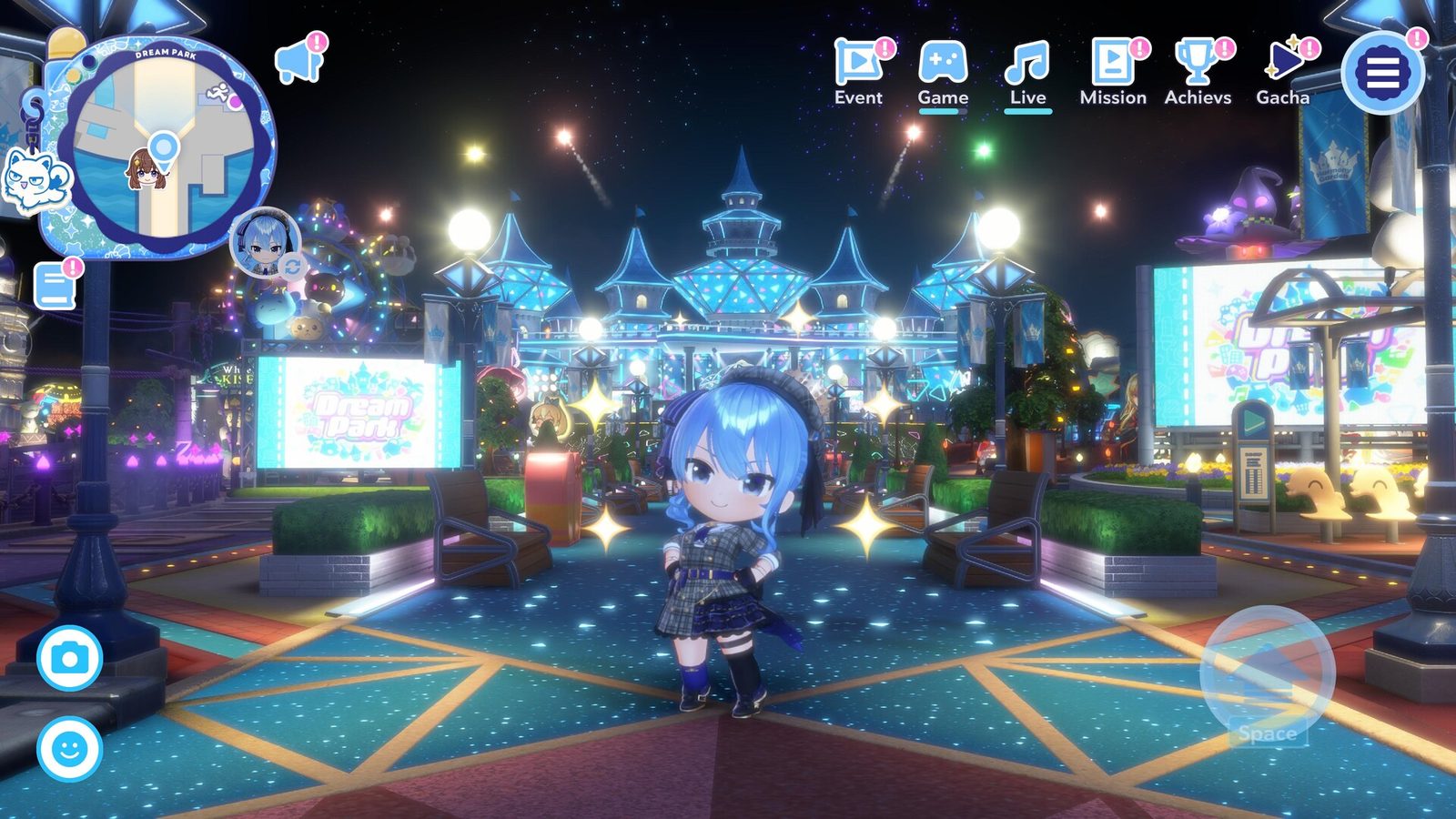
The second is the park. The setting is an uninhabited island somewhere, and clearing quests through rhythm lives and mini-games expands the facilities on it. Holomem quests unlock additional playable talents. Most of a first ten hours goes here: not grinding three songs to perfection, but attaching names to faces while the island fills in.
The third is mini-games, playable solo or with other people, including online co-op and online PvP. Sitting on top of all of it is the Create Chart feature, which lets players author charts, publish them, and play charts other people have made. The published charts range from difficulty exercises to jokes, which quietly turns a 150-song library into something much larger. Very few rhythm games ship that tool at launch.
Where you can actually install it
Availability is the first hurdle, and it is a real one. Checking Apple’s storefront data country by country, hololive Dreams appears on the Japanese App Store and nowhere else. Queries against the US, UK, Korean, Taiwanese, Hong Kong, Singaporean, German and Indonesian stores all come back empty. If you own an iPhone and have no interest in maintaining a Japanese Apple account, the game stops here. The Google Play package name ends in jp, and the listing shows more than 500,000 downloads and roughly 33,700 reviews.
Steam is the way around it. The Steam build is open worldwide and supports English, Indonesian, Simplified and Traditional Chinese, Japanese and Korean, with Japanese audio. In exchange it asks for 50 GB of storage, and the minimum specification is Windows 11 64-bit with a GeForce GTX 970 or Radeon RX 470 and 8 GB of RAM. For a rhythm game that is heavy, and worth checking against a laptop before committing.
Steam is also the minority platform by a wide margin. Concurrent players on Steam stood at 3,280 on August 23, 2026. The mini-games carry online co-op and PvP, so that number sets expectations for how quickly a PC player finds company. The centre of gravity is mobile: the Japanese App Store listing has accumulated over 90,000 ratings, the download weighs 603 MB, the age rating is 12+, and version 1.0.101 went out on August 5.
One small discrepancy is worth recording. The official news post dates the launch to July 23, while the Steam store page’s release field reads July 22, 2026. The gap is presumably a time zone, though no statement confirms it.
Accuracy is not the only thing that moves your score
To find what you end up paying for, read the store copy literally. The game’s own description tells players to raise their scores by training and arranging talents. Two players hitting the same chart with the same accuracy will not post the same number, because one of them has invested in cards, and cards come out of the gacha. That single line is the hinge connecting the rhythm game to the monetisation.
The pressure arrives once scores become rankings. The solo event running since the evening of August 17, Ultimate Summer For Me?, awards event points for rhythm lives and mini-games and ranks players on them, with the spotlight rotating to a different talent every two days: August 17, 19, 21, 23 and 25, each at 8 p.m. Short, repeating deadlines do more work than any rate table. The monetisation of this game lives in its calendar.
Commercially it landed. Sensor Tower placed hololive Dreams eighth worldwide among mobile games by revenue for July 2026, and July only contained nine days of service. PocketGamer.biz, in an article published on August 13 citing AppMagic, put the first week at $26 million. Estimates from different trackers diverge sharply on this title, so this review quotes one figure and names its source rather than blending them.
The free lane is genuinely wide. The rhythm game itself is decided by hands, and neither authoring charts nor playing other people’s requires a single card. A player who declines to open the ranking screen gets a 150-song rhythm game for nothing and can stay there for months. What breaks that resolve is almost always the ranking screen.
Bring an oshi or bring patience
The person best served here already watches hololive and has a favourite. That reframes the entire gacha: the motivation is a name, not a stat line. When the target list is one or two people, a pool carrying twelve extra 5-stars is survivable, and the original solo songs and park outfits attached to a card start paying for themselves.
Newcomers are not shut out. As a rhythm game alone, 150 songs is a generous library, and auto mode plus adjustable difficulty keeps the entry cost low. The problem is choice. Faced with 54 talents you cannot yet tell apart and a banner offering five new 5-stars at once, there is no basis on which to pick. This gacha asks you to spend affection rather than compare damage numbers, and if the affection is not there yet, the slot is simply empty.
It is also easy to say who should walk away. Anyone on iPhone unwilling to run a Japanese account. Anyone who wants a rhythm game where fingers alone decide the score. Anyone planning to live in the online mini-games on PC, where 3,280 concurrent players is the whole explanation.
If you are starting now, the practical move is to decide what you are aiming for before the August 17 banner closes on the morning of August 29 Japan time. The open question is what happens after summer. Swimsuit banners have arrived on a ten-day cadence, July 28, August 7, August 17, and nothing announced so far says whether that rhythm continues into the autumn or slows down enough for 5 percent to start meaning what it says.
Screenshots
Images: official Steam assets