Eighteen months after launch, Monster Hunter Wilds fell to $39.99 and a demo followed the next day
Eighteen months after launch, Monster Hunter Wilds has a permanent price cut and a free demo. Whether that makes it a good first Monster Hunter, with the PC performance saga and the 2027 expansion in view.
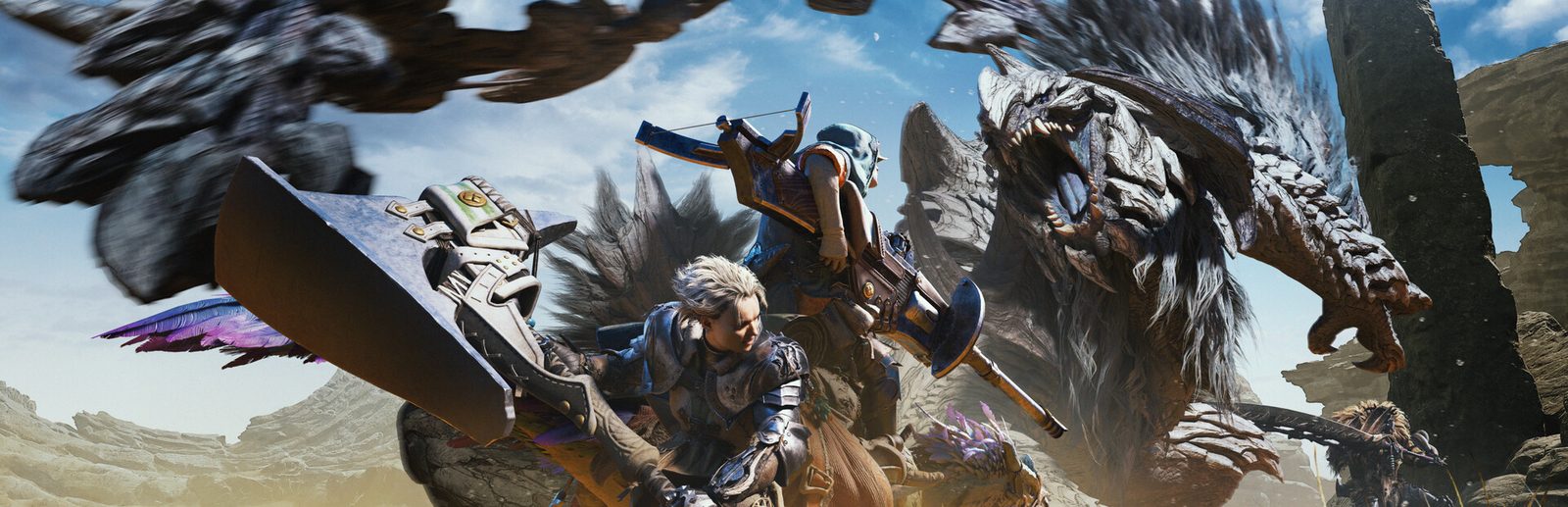
On August 5, 2026, a game that had been on sale for a year and a half received a free demo. The day before, its base price had been cut permanently. Demos and price cuts usually bracket a launch. For Monster Hunter Wilds they arrived eighteen months late, and the order in which they arrived says a lot about where the game stands. This is a guide to that situation as of August 22, 2026, written for someone who has never played a Monster Hunter game.
The short version of what the series is: Capcom has been making these since 2004. A hunt is a fight against one enormous creature that lasts somewhere around half an hour. You carve the creature, turn its parts into a weapon or a set of armor, and go after something bigger. There are no experience levels in the usual sense. Your gear gets stronger, and so do your hands. Wilds is the newest entry, released on February 28, 2025 for PlayStation 5, Xbox Series X|S and PC through Steam, with cross-play between all three from day one.
Why a Demo Shows Up Eighteen Months Late
Capcom’s own investor releases frame the arc. Wilds sold 8 million copies in its first three days and passed 10 million within its first month, both company records. Capcom’s platinum titles list then put cumulative sales at 11.8 million as of June 30, 2026. Ten million in the first month, 1.8 million in the fifteen months after. The opening was extraordinary, so the tail looks quieter than it might for another game, but that curve is the context for everything that happened this summer.
On July 14 Capcom announced it would stop selling the Deluxe and Premium Deluxe editions and the Cosmetic DLC Pass, and that the base game would get a permanent price reduction. On August 4 the cut took effect. On the US Steam store the game went from $69.99 to $39.99, and a new Gold Edition bundling the base game with a cosmetic collection replaced the old editions. On August 5 the Prologue Demo went up on PS5, Xbox and Steam. It covers character creation through the start of Chapter 1-3, runs offline, lets you try all fourteen weapon types, and carries its save into the full game. One catch: the transfer only works if you launch the full game with no existing save, so the order matters. The download is over 26 GB.
There is a second reason for the timing. At Summer Game Fest in June, Capcom announced Monster Hunter Wilds: Ascendance, a large paid expansion due in 2027 on PS5, Xbox Series X|S and PC. Lowering the base game’s barrier ahead of an expansion is the playbook Capcom used with Monster Hunter: World and its Iceborne expansion, and that earlier game has since passed 30 million copies including the expansion, the company’s best seller.
The First Ten Hours on a Seikret
You start by building a hunter and a cat companion. The character creator is deep enough that spending an hour in it is common. The story then sends you into the Forbidden Lands, an uncharted continent, as part of an expedition. The biggest change from older entries is the Seikret, a bird-like mount that carries you to your target automatically and lets you sharpen your weapon and heal while riding. The effect is that a whole region plays as one continuous space instead of a set of loading zones.
The first ten hours go roughly like this. The opening plains pit you against slow, readable creatures so you can learn the controls. A couple of hours in, the game moves you to a forest region and faster opponents, and that is where Focus Mode starts to click. Hitting a monster repeatedly opens wounds on its body. Aiming into a wound with Focus Mode deals heavy damage and topples the creature. In earlier games, knowing where to hit was something you learned from a wiki. In Wilds the screen tells you. The series has never been easier to get into.
At the ten-hour mark you are in the middle of the story and still in Low Rank. The loop the series is actually built around, hunting the same creature repeatedly for parts and tuning a build, only begins after the story ends and High Rank opens. The story alone runs about twenty hours. Past that, a hundred hours is ordinary.
Fourteen Weapons and What You Pay For
The fourteen weapon types are the great sword, long sword, sword and shield, dual blades, hammer, hunting horn, lance, gunlance, switch axe, charge blade, insect glaive, light bowgun, heavy bowgun and bow. Each plays like its own game, and Wilds lets you carry two and swap mid-hunt. Since the demo unlocks all fourteen, the sensible use of it is to find out whether any of them feels right before you pay.
On payment: there is no gacha. You buy the game once, and every monster, quest, weapon and armor set is earned in play. The four free Title Updates between April and December 2025 added Mizutsune, Lagiacrus, Seregios, Omega Planetes and Gogmazios, plus a permanent Final Fantasy XIV collaboration, and the anniversary update on February 18, 2026 added Arch-tempered Arkveld and a Monster Hunter Stories 3 side mission. None of it cost anything. You can pay in two places. The first is cosmetic DLC: more than 160 individual items on Steam, covering outfits, gestures and weapon skins, none of which affects performance and none of which you need. The second is consumables such as character edit vouchers. Compared with a gacha game the pressure is low, but plenty of players dislike cosmetic storefronts on principle, and the volume of them was one of the complaints that fed the review collapse described below. Ascendance, when it arrives, will be a paid expansion.
The Year Steam Reviews Fell and Climbed Back
No honest account of Wilds skips PC performance. From launch, the Steam version drew reports of frame drops, stutter and crashes. By June 2025 the recent-review rating on Steam had fallen to Overwhelmingly Negative, with performance complaints piling on top of criticism about the monster count, the thin endgame and the cosmetic store. Capcom’s answer came in stages. Title Update 4 in December 2025 included more than a hundred CPU and GPU optimizations across all platforms. On January 27, 2026 a Steam-only patch, Ver. 1.040.03.01, reworked shader preparation and texture streaming and added CPU-side options for endemic life display count, foliage density, effect quality and animation quality. The February 18 update, Ver. 1.041, carried a further round of optimization work.
As of August 22, 2026 the overall Steam rating reads Mostly Positive and the last thirty days read Mixed. The worst is over. It is not unanimous. The newest version, Ver. 1.042.00.02 from August 14, exists specifically to fix frame rate drops introduced by the version before it, and Capcom’s notes for it recommend NVIDIA driver 581.57 or later and AMD 25.9.1 or later while flagging problems with some newer AMD drivers on particular cards. The minimum spec is a GTX 1660 or RX 5500 XT with 16 GB of RAM and a 75 GB SSD; recommended is an RTX 2060 Super or RX 6600. A PC near the recommended line will need lowered settings to hold 60 frames per second. This is the strongest argument for the demo. Twenty-six gigabytes tells you how the game runs on your machine before you spend anything. The optimization story has been almost entirely a PC story; the console versions did not go through the same collapse.
What Is Left Before Ascendance
Wilds is now in the stretch between its last major free update and its expansion. The February 2026 update closed out the big content drops. Since then the changes have been bug fixes, the demo and its save transfer, and a welcome change in Ver. 1.042 that made the event quests which previously required an online connection playable offline. Ascendance is set for 2027 and, according to Capcom, continues the story with new areas, new monsters, new hunter actions and new quest ranks. In the same announcement Capcom said a Nintendo Switch 2 version of Wilds is in development, without a date.
Who it suits is clear enough. If you and a few friends enjoy fighting the same creature thirty times to complete a set, nothing else does this as well, and solo players get NPC support hunters and the full story. If you want a narrative game, or one you finish once and put down, you will likely stop after the twenty-hour story, and at that length $39.99 is not a bargain.
So the order of operations runs in three steps. First, the demo, to find out whether one of the fourteen weapons feels right and whether your PC holds a frame rate you can live with. Second, the edition: the base game is enough, the Gold Edition only matters if you want the cosmetic bundle, and a PC that fails the frame-rate test is a reason to run the same demo on PS5 or Xbox and buy there instead. Third, launch the full game with no save present, so the demo progress comes across.
Screenshots
Images: official Steam assets