A free-to-play game on Steam's top-seller chart, and the gem math behind Yu-Gi-Oh! Master Duel
Konami's online Yu-Gi-Oh! card game installs for nothing. The world championship final ended on August 30, and a new Selection Pack opened three days later. US App Store gem packs run $2.29 to $70.99, both mobile stores disclose loot boxes and ads, and no official page publishes pull rates.
The world championship final ended on August 30. A new card pack opened on September 3, three days later[1]. Yu-Gi-Oh! Master Duel is the online version of the card game that grew out of a manga serialised in Weekly Shonen Jump from 1996[2]. It costs nothing to download, and it is sitting on Steam’s top-seller chart, which ranks by money spent rather than copies moved. Everything below is as of September 3, 2026.
Three days between the final and the next pack
The reason the game is being talked about now is a calendar in which the tournament and the storefront sit next to each other. The Yu-Gi-Oh! World Championship 2026 ran from August 28 to August 30 in Ariake, Japan, with livestreams starting at 9:00 AM JST on all three days[1]. Master Duel was one of four categories, alongside the physical trading card game and the Speed Duel and Rush Duel formats of Duel Links[1].
The commercial half started nine days before the final. Konami’s Steam announcement of August 19 reads, in full: “Special bundles and alternate art cards are here for a limited time to celebrate the WCS 2026 Finals”[1]. Limited-time bundles, in other words, timed to the week when the largest possible audience was watching.
Kaiser on the Stage, the new Selection Pack, opened on September 3. The announcement lists two limited-time extended-art cards and a new archetype called Clown Crew[1]. An archetype, in this game’s vocabulary, is a family of cards that share a name and are built to work together.
The dates alone show the cadence. April 9, May 7, June 4, July 9, July 27, August 6, September 3[1]. Roughly one new pack every three or four weeks.
A starter deck and ten thousand cards
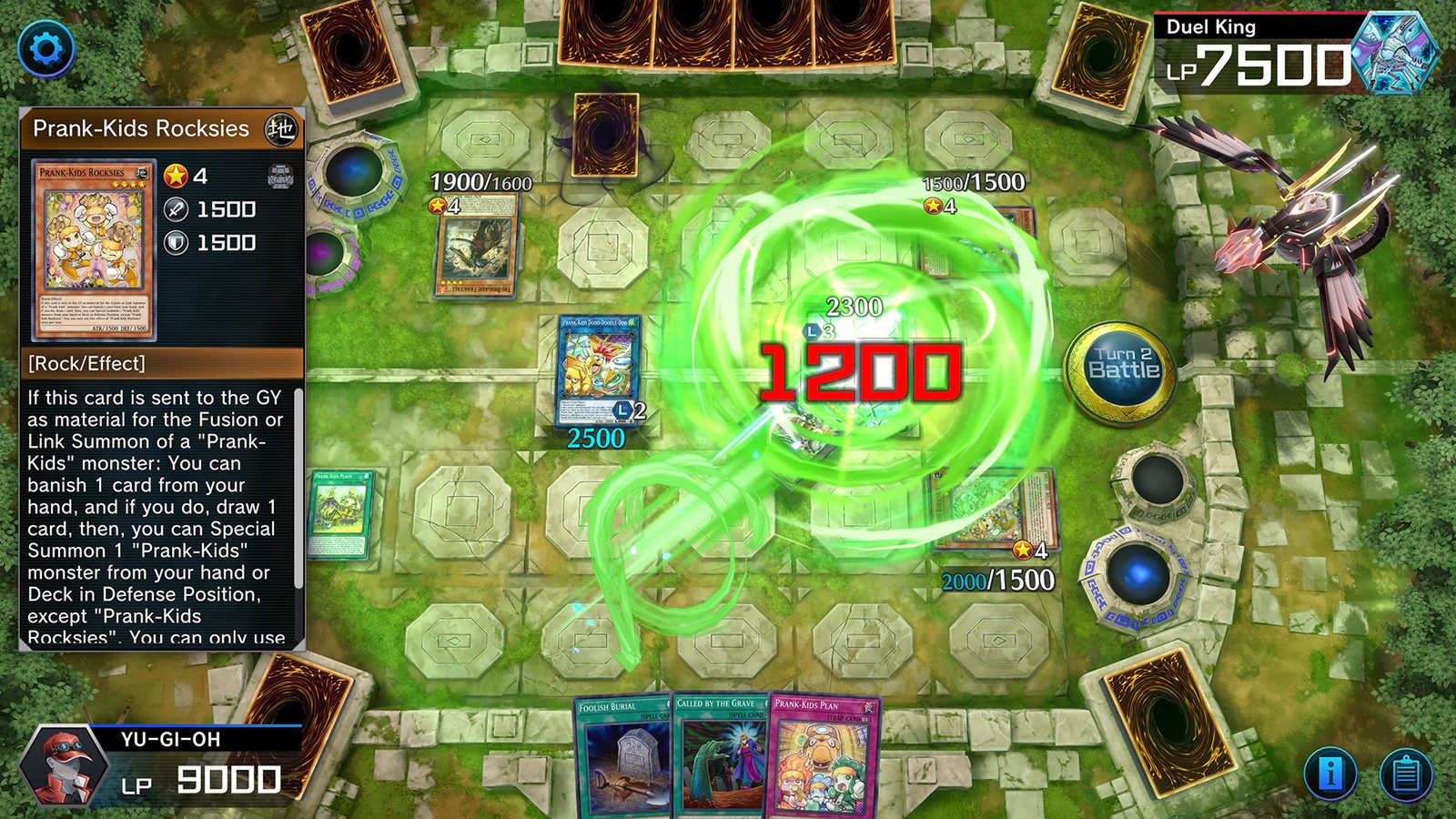
What you do is straightforward. You collect cards, build a deck and play one-on-one duels against other people. The Google Play listing tells new arrivals to start duelling with the deck they are given, and says a tutorial is included for returning players and first-timers alike[2].
There is a single-player half as well. Solo Mode works through staged encounters tied to the stories printed on the cards, and the same listing points beginners and returning players toward it[2]. For deck editing, the game connects to the Yu-Gi-Oh! Neuron companion app so you can look through decks other people have built, and a test-draw function shows what your opening hand tends to look like[2].
One number sets the scale. The listing puts the card pool at more than 10,000 distinct cards[2]. To a player who knows the rules that is a warehouse. To someone arriving cold it is a catalogue.
Even the genre label depends on where you look. Steam files it under Simulation, Strategy and Free To Play, and the words “card game” appear only in the user tags[3]. Konami’s own store copy calls it a digital card game that brings the Yu-Gi-Oh! OCG online[2].
How a free game climbs a revenue chart
Steam’s top sellers chart is weekly and ranks by revenue, not by downloads. A game with a price of zero appears on it because of what is sold inside. At the time of checking on September 3, 2026, Master Duel sat at 15 globally and 7 in Korea[4][5].
Those positions do not hold still. An earlier check the same day read 13 globally and 8 in Korea. The steadier figures are the ones printed beside the rank: four weeks on the global chart against 47 weeks on the Korean one, with week-over-week gains of 36 places globally and 21 in Korea[4][5].
Read together, the two numbers describe different situations. In Korea the game has been selling steadily for close to a year. On the global chart it arrived with the tournament season, and the limited-time bundles announced on August 19 sit inside that window[1].
A gem costs 1.64 cents, or 1.43
Payment collects at one place: buying gems, the in-game currency. The US App Store lists Gem Pack 140 at $2.29, Gem Pack 360 at $5.69, Gem Pack 700 at $10.99, Gem Pack 1420 at $21.49, Gem Pack 2350 at $34.99 and Gem Pack 4950 at $70.99, with four Welcome Gem Packs for new accounts sitting between them[6].
The unit price falls as the pack grows. Divide $2.29 by 140 and a gem costs about 1.64 cents; divide $70.99 by 4,950 and it costs 1.43. The largest pack costs 31 times the smallest and contains 35 times the gems.
Storefronts disagree about the floor. Google Play in the US states a range of “$0.99 - $79.99 per item”[2], which is both cheaper at the bottom and dearer at the top than the App Store ladder. Whichever one you open first is the one that sets your idea of what this game costs.
The loot-box disclosure is built into the age ratings rather than buried in a FAQ. Google Play’s US rating notes “Users Interact, In-Game Purchases (Includes Random Items)” alongside “Fantasy Violence, Mild Blood, Partial Nudity”[2]. The App Store’s 13+ detail says the app contains loot boxes and advertising[6]. The Steam page carries Konami’s own line about purchasing in-game virtual currency used to obtain randomly distributed items[3].
Advertising is the part most easily missed. Google Play prints a “Contains ads” badge under the developer name, and the App Store lists advertising next to loot boxes[2][6]. A free card game is not usually read as an ad-supported one.
What does not appear anywhere is a rate. Konami’s official Master Duel pages were opened in Japanese, English and Traditional Chinese and searched for 確率, 提供割合 and “drop rate”, and none of the three returned a match[7]. That the game contains loot boxes is settled by the store ratings. What each rarity actually drops at is not published on the web, which is why no percentage appears in this review.
What to check before installing
Hardware is not the obstacle. Android needs 7.0 and 4GB of RAM[2]. The Steam build is Windows only, with no macOS or Linux support[3]. PlayStation 4 and 5, Xbox One and Series X|S, and Nintendo Switch each have their own store listing, linked from Konami’s official site[7].
Language support is unusually flat. Steam lists English, French, Italian, German, Spanish (Latin America), Portuguese (Brazil), Japanese, Korean, Simplified Chinese and Traditional Chinese, and all ten are supported for interface and subtitles alike[3].
The release history has one wrinkle worth knowing. Steam and the consoles came first on January 18, 2022; the App Store version followed on February 2, except in Japan, where it arrived on January 26[8].
4.87, 4.4, and 71 percent
The same game scores very differently depending on the storefront. The US App Store average is 4.87 from 87,214 ratings[8], the US Google Play page shows 4.4 from 258,931 ratings[2], and Steam’s own user reviews stand at 101,290 total with 72,361 positive and 28,929 negative, summarised as “Mostly Positive”[9]. Close to three reviews in ten are negative.
The cause of that spread is not something this review can establish. The population leaving reviews differs by store, and Steam only accepts a thumb up or down. The verified part is the size of the gap.
Concurrent players move within a single day as well. Three checks against Steam’s official API on September 3 returned 18,115, 18,882 and 23,103[10]. Any number quoted for this game needs the time of the check attached to it.
The player this suits already knows the rules. Someone who has played with paper cards, or watched the anime, will know what belongs in a first deck. There is no shortage of opponents in a game that is still a world championship category.
The player it does not suit is easier to describe. If card games are new to you, one tutorial will not settle the rules. If you decide what to spend by reading a rate table, this game withholds the document you would use, because that table is not on the web.
The pack that opened on September 3 is limited-time. The three-to-four-week cadence held from April through September, so on that pattern the next one falls due in early October[1]. Waiting through one or two cycles before spending anything costs nothing. What is still missing is any published basis for judging what a $70.99 gem pack is worth.
Sources
[1] KONAMI. Yu-Gi-Oh! MASTER DUEL announcements. Steam, retrieved September 3, 2026.
[2] KONAMI. Yu-Gi-Oh! Master Duel. Google Play, retrieved September 3, 2026.
[3] KONAMI. Yu-Gi-Oh! Master Duel. Steam store page, retrieved September 3, 2026.
[4] Valve. Global weekly top sellers. Steam, retrieved September 3, 2026.
[5] Valve. Korea weekly top sellers. Steam, retrieved September 3, 2026.
[6] KONAMI. Yu-Gi-Oh! Master Duel. App Store, retrieved September 3, 2026.
[7] KONAMI. Yu-Gi-Oh! Master Duel official site. KONAMI, retrieved September 3, 2026.
[8] Apple. iTunes Lookup API, id 1554247785. Apple, retrieved September 3, 2026.
[9] Valve. User review summary API. Steam, retrieved September 3, 2026.
[10] Valve. Current player count API. Steam, retrieved September 3, 2026.
Screenshots
Images: official Steam assets